




July 25, 2012
An article at GA News reminded me that Rod is still around with this newest idea, and I am all for it.
My attempts to rent across the country generally were unsuccessful. In all cases, the biggest impediment was utter lack of transparency in operation of FBOs, accompainment by the lack of clear rules as to who gets to rent and who is denied (like me). When I come to rent, the owners agree to run a "checkout": a flight test with a staff instructor that evaluates me. You can see how this may be problematic already: the owner, for instance, may easily reject me for my skin being too pale or for an accidential admission of being heterosexual, and I'll never have a case. CFI can easily bust anyone. In reality, however, it does not happen: that part is above the board. I pass a checkout and CFI reports it to the management. Thereafter, however, the wiggling starts. They won't tell me I'm unsafe, but... In one case they declared that the airplane I wanted to rent was too busy due to sudden influx of students after an ad they posted. Okay, how about another one? Weeeeeeeell...
Having OpenAirplane in the picture is going to bring useful transparency into these decisions. Of course, FBOs can game Rod's franchize just like they do it now: yes, sir, you are qualified, but no, you cannot rent because this and that. Beatting this habit out of them is going to be a big job for Rod. However, I do expect that if an FBO carries OpenAirplane approval, it is going to be more standards-compliant and uniform in the way they do business, by comparison. And it's going to bring them competitive advantage. The question is, how big.
The article linked above mentioned 4.9 million hours per year in the rental market. This figure is under the pressure to fall, as number of pilots drops in the country. However, it may be made to grow as owners give up personal airplanes, if only rent is made easier. Right now it's anything but.
Posted by: Pete Zaitcev at
06:57 PM
| No Comments
| Add Comment
Post contains 353 words, total size 2 kb.
July 24, 2012
In a major strategy shift, Cessna Aircraft announced at EAA AirVenture that it was removing its 162 Skycatcher from the light sport aircraft category into a primary aircraft category. The manufacturer made the move to help speed up certification of the single-engine piston aircraft in Europe and the rest of the world.
"The Skycatcher will be transitioned into the primary category, and will continue to meet the definition of a light-sport aircraft," said Tracy Leopold, business leader for the Cessna 162. "The owner operator can continue to operate the aircraft with a sport pilot license. This makes the Skycatcher a more innovative aircraft for our customers."
Skycatcher is not the only Primary category airplane that is Sport Pilot eligible. There is another: ACA 7EC Champ. Yes, it is still made and sold. A miracle, really, in a world where Mooney folded, Piper is The New Piper, and Bonanza is made by a Chinese company. Interestingly enough, Champ is cheaper than Skycatcher: $116k vs $145k in 2012 list prices.
Note that although an owner can fly 162 and 7EC on Sport license, he cannot maintain them - at all. Not even an oil change. This may be a major impediment for non-business purchasers. Only Private pilot license permits preventive maintenance on Primary category aircraft.
P.S. In a memorial to the failed experiment, two airplanes certified in Recreational category still exist: RANS S-7 and Quicksilver GT-500. Both are Sport eligible, and RANS currently sells S-7LS made under ASTM rules. So if you are a Sport pilot who 1) hates making hands dirty, 2) hates buying used airplanes, and 3) hates LSAs, then you have 4 airplane types to buy!
UPDATE: James Lawrence read the actual regs, and apparently Primary category prohibits business use, while permitting incidential instruction only. This may be the other big reason why certification of Skycatcher does not add a weight increase: all Skycatchers sold in America are going to continue to have pink airworthiness certificates.
Posted by: Pete Zaitcev at
09:02 AM
| No Comments
| Add Comment
Post contains 338 words, total size 2 kb.
July 18, 2012
Did not see this coming, did we? As reported by Russ Niles of AvWeb:
ICON Aircraft has asked the FAA for an exemption from the upper weight limit for amphibious Light Sport Aircraft to incorporate what it says are important safety features in its A5 aircraft. The company says it needs an additional 250 pounds above the current weight limit of 1430 pounds to accommodate the extra wing and tail surface area, and attendant structural components, to make the aircraft spin resistant. That's roughly the equivalent of the weight of a Cessna 152.
We touched upon the weight problem of A5 before, in particular due to structural interior parts. So, just one more thing. If Icon succeeds in gaining an exemption to sell a 750kg LSA, they'll have to fly that on a 100 hp Rotax engine. But C-152 flies on a 115 hp Lycoming O-235. A better comparsion would be C-150. You don't want to fly that A5 off one of Colorado lakes.
At last January's Sport Aviation Expo in Sebring, FL, EAA President Rod Hightower announced the FAA was considering allowing weight exemptions for LSAs for safety-related equipment.
A precendent exists in ultralights, where 12 lbs exemption is given for safety equipment. Result is typically an ultralight that cannot be legally flown without a chute: its intrinsic mass is greater than the legal limit.
Also! Note how they slipped it through before the structural interior came to light:
The submission was first published by the FAA in the Federal Register in May (we missed it) and the comment period for that submission has closed. However Independent Aircraft Inc., which makes a composite LSA amphib called the SeaDragon that meets current weight requirements applied for and received an extension to the comment period (PDF) to address what it said were important issues related to ICON's request. Comments are being accepted until July 27.
Hurray for market competition. The website of the nosy competitior lacks some key information, such as the engine type. Clearly their product is not ready for market yet. But since SeaMax existed for years now, there's nothing impossible about an LSA seaplane. SeaMax even meets the 1320 lbs (600 kg) limit, not the extened 1430 lbs limit that A5 failed to meet.
UPDATE 2013/07/30: Exemption is granted up to 1680 lbs. The initial version is planned to ship at 1510 lbs.
Posted by: Pete Zaitcev at
06:17 AM
| No Comments
| Add Comment
Post contains 403 words, total size 3 kb.
July 13, 2012
There a remarkable article at SpaceNews by Peter B. de Selding today. It mostly focused on Reaction Engines, Skylon, and SABRE, but also contained this -- please pardon the length:
The New European Launch Service is a reversal of ESA’s past practice with respect to major developments. In the past, the agency would work with its governments to determine each nation’s level of enthusiasm for a given project. A budget would be set after the national contributions are added together, and only then would an industrial team be assembled.
This procedure has had the disadvantage of forcing ESA to build launchers with industrial contracting teams spread throughout Europe, with the size of each company’s role determined in advance by the level of its government’s commitment.
The resulting Ariane 5 rocket has been more expensive to build and maintain — so much so that the successful, mature vehicle requires some 120 million euros a year in ESA government support payments.
The new bid requests permit the industrial teams to design their own rockets without worrying about which government will contribute to it. Dordain has said the primary goal is a vehicle that will not need support payments under normal operations once it has proved its design.
If that ends up being a rocket built almost entirely in just one or two nations, so be it. These nations then would be asked to finance it.
ESA officials have been spooked by Space Exploration Technologies Corp. (SpaceX) of Hawthorne, Calif., which has demonstrated its technical prowess with the launch of its Falcon 9 rocket and Dragon cargo vehicle to the international space station. SpaceX officials say one of the keys to its success is that Falcon 9 is built in one factory owned by SpaceX.
"That’s not building an industry, it’s just building a company,†scoffed one official with a commercial rocket supplier competing with SpaceX. But for European government officials concerned about the long-term viability of their Ariane rocket line, SpaceX has become a useful case study of one way to cut costs.
The rocket design sought by ESA would be capable of placing satellites weighing between 3,000 and 6,500 kilograms into geostationary transfer orbit, the destination of most telecommunications satellites.
Estimates of how much it would cost to develop such a vehicle vary between 3 billion euros to 6 billion euros over 10 years or more. That alone may turn off European governments when they meet in November and decide whether to upgrade the current Ariane 5 or start development of a new rocket.
Remember how someone outlined the biggest problem hobbling NASA today: "We do not have a space program, we have a jobs program." Europe is no better, but at least they are trying to fix things. Still, SpaceX spent $1.2 billion to date on all-new engines, Falcon 1, Falcon 9, Dragon, and launch infrastructure. Those are factual expenditures (of which the U.S. Government covered about 30%). But the new, cheap, European launcher ("Ariane 6") is going to cost 3 billion Euro before the inevitable cost overruns, and not include a whole spaceship in the deal. Just think about it.
As a side note, performance of both Falcon 9 (which is real), and "Ariane 6" (which is imaginary at present) is equally underwhelming, considering that Proton has just boosted a 6-tonne SES-5 a couple of days ago. However, there's a difference: Falcon is going to be enhanced in the coming years, while "Ariane 6" is not. And if ESA try to re-adjust the requirements, it will delay the project. To plan for a GEO launcher that tops out at 6,5 tonnes in 2022 seems ridiculously ill-advised to me. But that is unimportant, really. The important part is that they still cannot touch SpaceX's efficiency, even though SpaceX was bloating really quickly in the last 5 years.
Tags: space
Posted by: Pete Zaitcev at
04:36 PM
| Comments (2)
| Add Comment
Post contains 644 words, total size 4 kb.
July 12, 2012

I don't know if the bottom is truly out of the market or what, but have a look at this 1940 Aeronca Chief: LSA-qualifying, 275 SMOH, full logs, etc. etc. for TEN THOUSAND DOLLARS ($10,000). Insane!
UPDATE: It's interesting to observe how this airplane is better in many respects than airplanes of the same class and mission, only made 40, 50, 60 years later. I would not be mad enough to drive a 1940 car daily, a 1940 gun is obsolete, a 1940 computer did not even exist, but a 1940 airplane is quite competitive today, except in avionics (and the need for tailwheel endorsement). The 2020 ADS-B mandate is going to put a bit of a clamp on its utility, but even so, as a flying machine, it is still doing strong.
Posted by: Pete Zaitcev at
09:32 AM
| No Comments
| Add Comment
Post contains 140 words, total size 1 kb.
July 11, 2012
Virgin Galactic (not Scaled, SNC, SSC, or Stratolaunch) announced today that they are going to build a rocket to launch small satellites, in 225 kg class. Clark Lindsey has convenient notes: air-launched, 2-stage, all-liquid, 4 customers have paid deposits. Today's announcement follows a previous abortive effort to source the launcher in England (from Surrey Sat. IIRC). This project is going to be fully developed in-house by Virgin in Mojave.
Commenters already compared LauncherOne with now-dead SpaceX Falcon 1(e). I will only note that the decision to drop F1e was not necesserily based on its ability to break even, and could have something with the expansion plans of SpaceX. When you are about to launch Dragon, who in the company is going to waste their time on a light launcher, yesterday's tech, fighting for resources?
More interesting is the critique of Pegasus by Elon Musk. How much of it applies to LauncherOne?
- The need to maintain a fixed asset: Still applies, but may be effectively mitigated by the use for VG's suborbital business, assuming said business materializes.
- Marginal safety of air-launch: Still applies in full.
- Excessive complexity of Pegasus: Does not apply. There is no hypersonic airplane anymore, and only two stages.
Or, to quote Elon himself:
If you look at ours in contrast: it is a two stage rocket, no wings, no control surfaces, both stages are the cheapest propellant you can use, LOX/Kerosene.
Hah! The dead English LauncherOne was somewhat reminiscent of Ishim: a 4-stage solid rocket, with motors sourced from legacy contractors. No wonder if was DoA.
The big question now is if VG is capable of delivering on the price point.
UPDATE: Jeff Foust adds:
Airlaunch systems aren’t new, with various concepts having been proposed over the years, as well as Orbital’s Pegasus, which has been flying for over two decades. Pegasus hasn’t won much business because of its price, estimated to be on the order of $30 million. Several years ago, SpaceX was going to open up the smallsat launch market with the Falcon 1, which originally was to launch about 600 kilograms to LEO for $6 million; the payload capacity later declined to about 420 kilograms as the price increased to around $9 million. Later, the Falcon 1e was to provide approximately 1,000 kilograms for $11 million, but the company withdrew the vehicle from the market, citing limited demand. While Virgin does have customers lined up, as it announced today, its prices may have to fall significantly below $10 million per launch to sustain demand over the long term, given the vehicle’s performance and the history of previous smallsat launch efforts.
UPDATE: According to pictures of Sir Richard playing with the model in Farnborough, it does have wings after all. Good grief, he just bought himself a lot of expensive R&D.
Tags: space
Posted by: Pete Zaitcev at
10:43 AM
| No Comments
| Add Comment
Post contains 470 words, total size 4 kb.
July 10, 2012
I think I remember dimly hearing about the FLY-UL list back in the 90s. And it looks like the resource for the fans of ultralights. It moved to Yahoo Groups, but so did many other lists, whenever they were ran by people other than hardcore UNIX nerds.
Numbers of messages after the move to Yahoo are available. 2002: 26769, 2003: 11748, 2004: 8977, 2006: 6661, 2008: 2813, 2009: 1671, 2010: 835, 2011: 884. This is nothing short of collapse.
Now, mailing lists collapsed all around as their users migrated to web forums in recent years. But where did all these people go? My research so far failed to identify a forum about ultralights. All that exists are forums for builders of ultralights. They are always adjacent to forums for builders of experimentals.
It looks like ultralights died in America despite being less regulated and cheaper than even LSAs. This is not good news for affordable personal aviation in general. But what has happened?
I think the demise of "fat" ultralights was the main reason. When the vise of regulation closed, the supply of neophites to ultralights was cut off. These days, the only non-suicidal way to get into an ultralight is to "downgrade" from GA, because without "fat" ultralights you cannot train in one. Even so, transition training is very difficult to find. Remember that I spent $14,400 in 2010 dollars to get a Private ticket. A person buying a used ultralight for $8,000 may simply not have the budget.
Posted by: Pete Zaitcev at
08:29 PM
| No Comments
| Add Comment
Post contains 255 words, total size 2 kb.
June 28, 2012
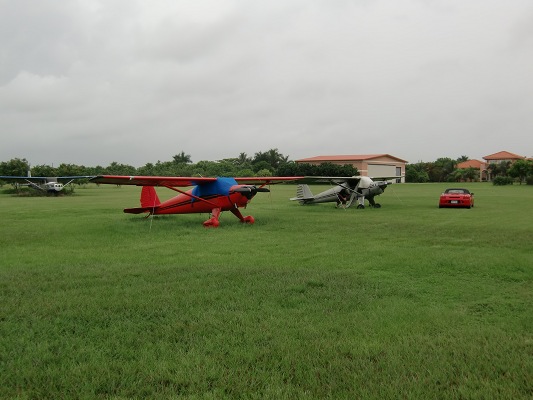
While on vacation, I scored a seat check in Luscombe 8A. We did not go around the pattern, but no matter. My experience with high-wings permits me to say that Luscombe offers a middle-of-the road visiblity, better than Remos GX. All in all, it seems surprisingly livable. I still think that a 1976 vintage 150 would make a better airplane for me. It is cheaper, for one thing. Electrical system (meaning operations inside Mode C veil), hydraulic brakes, nose gear. But Luscombe is probably the best of the 1946 stable, among Stinson, Taylorcraft, etc. There's no way for me to fit into an Ercoupe at all.
Posted by: Pete Zaitcev at
08:42 PM
| No Comments
| Add Comment
Post contains 109 words, total size 1 kb.
June 27, 2012
Check this out: a DIY hoist for a jeep hardtop:

Now I can pop the top off for a quick trip to a local off-road area. Before it was too much trouble, so I only did it when my wife was out of town. It was not feasible to reconfigure it back as family SUV quickly.
Posted by: Pete Zaitcev at
10:01 PM
| No Comments
| Add Comment
Post contains 58 words, total size 1 kb.
Posted by: Pete Zaitcev at
08:12 AM
| No Comments
| Add Comment
Post contains 27 words, total size 1 kb.
June 12, 2012
Questioning the weight of Icon A5 seems like a great excuse to post my table of useful load of various LSAs. Values are in U.S. pounds (lbs). Behold:
| Type | Book | Real | Note |
|---|---|---|---|
| Allegro 2007 | 673 | 682 lbs advertised in 2012 | |
| Dova Skylark DV-1 | 643 | As advertised on 2010 model sold by SkyView | |
| Remos GX | 615 | 631 | Real on N28GX (no BRS), 650 lbs book on a 2010 stripper before LiTE |
| Evektor SportStar | 640 | ||
| RANS S-6LS | 620 | ||
| Alto | 610 | ||
| Aerotrek A-240 | 596 | ||
| Allegro 2000 | 594 | Real on Frank's | |
| P92 Eaglet | 590 | ||
| CTSW | 574 | ||
| X-Air LS | 574 | ||
| CTLS | 550 | 505 | Real on N505MA |
| P2002 Seirra | 540 | ||
| Cessna 162 | 481 | 426 | On N60020? |
| Icon A5 | 430 | According to 2012 brochure; 530 max with no gear or electric folding | |
| Sky Arrow | 453 | Real on EddieB's | |
| ACA 7EC Champ | 395 | Low useful load is disqualifying as an ASTM LSA |
As we can see, the useable load of A5 is lower than that of competitive designs, and corresponds to heavy LSAs such as Tecnam Seirra and Cessna 162. Sierra is a real airplane, certified in Europe for IFR. It carries equipment such as redundant alternator and is quite stout. The C-162 is an LSA designed using Cessna tradition and intended for training market. Aside from student-resistant aluminum construction, it carries a penalty of O-200-D engine.
In my opinion, a businessman or executive who wants a jet ski with wings should be quite comfortable flying A5, as long as he does not give rides to fat chicks. This, however, depends on Icon staying within the weight budget. And even so, usefulness of the airplane is not competitive, if any amount of travel is included into the mission. Think how much you weigh (220 lbs), how much your spouse weighs (170 lbs), add fuel for 4 hours of flight (96 lbs), and suddenly you cannot carry a toothbrush within the likely weight limits of A5.
So, today GAN posts this:
Lotus engineers are working alongside ICON’s designers on-site at ICON’s facilities in California to supplement the ICON team. The joint team created the structural design and manufacturing concept of the interior, in which all cosmetic parts also act as structural parts. This eliminates the need for hidden structure, reducing weight and complexity, officials note.
Oh, brother. Structural interior parts? Smells like a last-ditch effort to shave weight.
Previously on Icon A5: [videos], [cuffed wing], [flaps].
UPDATE a month later: saga turns into a farce.
Posted by: Pete Zaitcev at
04:40 PM
| No Comments
| Add Comment
Post contains 413 words, total size 4 kb.
June 09, 2012
There was a Grumman fly-in at Carlsbad (KCNM) today, and I dropped in hoping to bum off a fit check in an AA-1. But I only found a ramp full of parked Grummans, and not one pilot. Apparently they all went to see the caverns.

Instead, the excitement of the day was the smoke trail from a fire west of Sierra-Blanca. It's a good thing I decided to go on the north side of the ridge. I completely forgot about the smoke when I planned the flight, but I wanted to stay out of the way of firefighting aircraft shuttling between the fire and KSRR, and so I went by the CNX and CME.
UPDATE: Here's a picture of the plume taken by NOAA weather satellite GOES:

Red dot is where the plume originates. Blue dot is the location where the picture was taken.
UPDATE: Apparently the fire is known as "Little Bear" and it's raging out of control. Ruidoso is threatened, with about 30 outlying houses already gone. On Saturday, I saw a SkyCrane dispersed for refueling as far as Clovis. The Sierra-Blanca and Alamagordo may be running low on jet fuel necessary for firefighting aircraft.
UPDATE 2012-06-12: TFR is extended almost to KSRR now.

However, the fire is reported 30% contained.
Posted by: Pete Zaitcev at
04:00 PM
| No Comments
| Add Comment
Post contains 217 words, total size 1 kb.
May 26, 2012
I went on a tour of Spaceport America, since it's in the neighbourhood.

The most amusing part was the pride with which our guide related the story of a corrupt Democrat governor distributing the work contracts through the system of patronage, which excluded qualified outsiders from bidding. The inefficiencies of crony capitalism are then patched with pieces cut from my hide, for the benefit of other locals — the ones known to Richardson.
The runway structure is most impressive. However some of the dirt embankments are already eroded. I did not see any trace of centerline lighting wells, so I'm not sure what exactly Dr. Gurman meant when he talked about the wiring pre-positioned. Perhaps I misunderstood.
Oh, and one funny bit: the taxiway to the terminal is marked "V" (Victor). It actually makes sense, considering the master plan: future tenants are going to have their own taxiways, instead of using Virgin's apron, so we may expect "S" for SNC, for example.
Posted by: Pete Zaitcev at
06:51 PM
| No Comments
| Add Comment
Post contains 165 words, total size 1 kb.
May 20, 2012

This is a repost from Sport Pilot Talk.
- quoth -
The 2012 Expo was much the same as the previous year. There were some changes. For example, last year I flew the only airplane overnight from Friday, this year there were two (there were going to be more, but they cancelled or landed short for weather). Organizers moved us into a hangar away from the gusting winds and hail.
It looked like the show was set for a more robust growth, or perhaps the organizers gained experience. They knew ahead of time who would be going where, had display areas set up ahead of time, and laid down the equiplemnt such as power strips and public address loop.
The crowd was thinner, but more purposeful. I remember how I lampooned Paul Bertorelli for saying that crowd at Sebring 2011 was "thin but potent". Oh baby, that crow is so tasty. In RM LSA Expo case, it was noticeable how the last time most of local visitors were just typical airshow-goers, but this year most were shoppers, or at the minimum tire-kickers. My co-pilot, Chuck, was in the market. He struck down 162 ahead of time, but reconsidered after sitting in one, so it's back on his list now. Ironically, this was a working aircraft from a school at KAPA, and it wasn't for sale or a demo. The local Cessna dealer was a no-show, but is going to get the benefit.
In general, dealers cancelled left and right. Maybe organizers should take advance deposits from them, like $500. Aside from Cessna, I noticed that RANS stood us up despite being based rather near, in Kansas. I already had a chance to examine S-6ES, closely, so I lost nothing, but Chuck was sorely disappointed. He wanted to check out the S-19 Venterra. Pipistrel rep swore that they were going to bring a Virus for the show, but it got stuck with weather halfway. Perhaps so, but Kansas was basically clear for VFR. We came up to the show through a mountain pass for Pete's sake.
I worked as a volunteer booth babe for an hour or so around our Remos GX rental. Curiously enough, nobody noticed that the engine on it throws oil now, and the belly is dirty.
P.S. By the way, Jim Lee brought his amazing Phoenix from Florida last year. IIRC he overnighted short and flew in very early on Saturday. This year apparently he had his daughter's graduation, so skipped as well. I'm kinda bummed about it.
- end -
Posted by: Pete Zaitcev at
11:41 AM
| No Comments
| Add Comment
Post contains 430 words, total size 3 kb.
I flew to Denver for Rocky Mountain LSA Expo on Saturday, and went through the La Veta pass both ways. It is the easiest mountain pass in Colorado, a pass with training wheels, if you will. Nonetheless, my Denverite friends, Nate and Blanche, were always piling on me about how terrible it is to fly mountain passes. Blanche flies a Cherokee 180 and I'm pretty certain that she takes La Veta or Mosca every time she goes our way, and she saw the pass closed many times. The problem is, if you commit to going up the valley from Santa Fe, you don't have any options. Turning back will cause an enormous delay and set you short on fuel. Nate flies a 182 with a Robertson kit and he was a Search and Rescue volunteer for many years. Since he's all too familiar with the aftermath of poor ADM (Aeronautical Decision-Making), naturally he keeps rapping how those darned flatlanders litter aluminum all over Colorado mountains and they reeeeeealy should think if trimming 20 minutes off is worth killing one's family. The time en route for Santa Fe to Front Range in a GX is 2:40 through La Veta and 3 hours around the lowlands.
I would've gone around at least on the way up, and in fact I filed SAF-FTI-CIM-PUB-FTG. However, my co-pilot Chunk, a charter pilot with 6000+ hours, filed SAF-ALS-PUB-FTG. The weather was great, the only concern being the winds gusting to 35 at ALS, according to TAF. However, La Veta is very wide, so it does not amplify a lot. Also, it was blowing from the west, so winds were pushing us up on the entrance and down on the exit. There was ony time on the exit when I was staying on full throttle and Vy and losing 500 fpm. In a couple of minutes, it threw us from 11.5 down to 10.5 and going down fast. Chuck only asked: "Did you lose that 1000 on purpose?" As it turns out, his personal ride is a pressurized Cessna 340. Yeah. No prop full-forward on an LSA.
On the way back we had to hug the ground for a bit, then dodge scattered nimbocumulus while climbing away from Colorado Springs. The pass was clean, however. We took it safely at 11.5 again, going south around the "sugarhead" with the gravel slides, instead of the road.
Overall, La Veta is as easy as they come, just need to watch out for the weather and not commit from the west if it may be closed. Perhaps what gets people is that La Veta really is too easy and they tend to get complacent about diversion criteria: get under ceilings, in howling winds, and then press on instead of backing off. It's especially tempting when coming from the west, because nobody wants to divert to Alamosa.
Posted by: Pete Zaitcev at
11:09 AM
| No Comments
| Add Comment
Post contains 480 words, total size 3 kb.
May 14, 2012
For a good part of his diatribe, Mr. Collins is building an argument about the deficient Cirrus pilot stereotype, when suddenly... this:
Normally a single-engine airplane has to be spun as part of the certification process. The Cirrus wasn’t. The FAA waived this requirement and accepted the airframe parachute as an alternate means of compliance. I kid you not, the spin recovery in a Cirrus is based on deploying the chute. That is the only way a pilot can recover from a spin in a Cirrus.
Two things:
#1 It's a lie. Cirrus recovers from a spin just fine, and it was spin-tested for certification in Europe.
#2 Let's assume that that SR-22 were not recoverable. What then? The answer is: absolutely nothing. The reason FAA removed spin training from the Private Pilot curriculum is very simple: spins almost exclusively happen at base-to-final turns, and there is almost never enough altitude to recover in such case. Therefore, pilots should be taught to avoid spins instead. And so they were, for decades now. It does not matter one iota if their airplanes can recover.
That whole paragraph is utterly bogus and had no place in the post. To paraphrase, I knew Richard L. Collins, he was a friend of mine, and this is no Richard L. Collins.
Posted by: Pete Zaitcev at
01:28 PM
| No Comments
| Add Comment
Post contains 221 words, total size 1 kb.
May 06, 2012
Went up for practice, using the agenda of WINGS activity that would count for 1/3rd of BFR. We ended doing the kinds of things that I diligently avoided back when I was a student, except perhaps a base-to-final spin! I possibly came close to a gear-up, because of dealing with pattern traffic, although we'll never know if I actually did, because my instructor caught it. Also, at some point I took off prematurely and, despite my best efforts, ended settling down on the runway. Good thing I did not settle into bushes beyond, and that gear was still down. The lesson is: never force an airplane to fly if she does not want to. That aside, I bounced gently and kept it in the ground effect to gain the missing 5 knots that allowed us to climb. Still not sure if it were a safer choice to close the throttle and brake in the remaining distance. We practiced an aborted takeoff, too, but come the decision time, I chose not to abort. Perhaps I should not agonize over it, considering that there was no damage, but make a mental note.
UPDATE: See comments at PoA.
Posted by: Pete Zaitcev at
07:01 PM
| No Comments
| Add Comment
Post contains 200 words, total size 1 kb.
April 28, 2012
With a post to PoA, another student -- Sara -- announced a passed checkride, and is a certificated pilot now. What makes it remarkable is that she has about as much time on the Hobbs as I do: no less than 150 hours by my estimation (a year ago she had 130). It took her 2 calendar years.
Posted by: Pete Zaitcev at
06:18 PM
| No Comments
| Add Comment
Post contains 62 words, total size 1 kb.
April 26, 2012
I had a funny experience on the way to Clovis: I got lost for the first time. I read about student pilots getting lost, but managed to rack 150 hours without, and started to think that I may be invulnerable.

It should to be noted ahead that N2966V has a broken VOR receiver (which was broken for more than a year and finally was placarded instead of repaired). It also has a broken 12V outlet, so I cannot power my AV8OR and monitor my progress on its moving map. AV8OR has a battery, but the life time is pathetic, less than an hour. Having flown the aircraft to Artesia, I thought it would not be a problem, thanks to my supposedly superior pilotage skills. Just in case, I took a civilian GPS, Garmin Oregon 400t, which I use sometimes to capture flight track. It is powered by AA batteries and its battery life far exceeds the time aloft of the C-150.
But I did not account for the terrain features, or rather lack of them. By comparison with central NM, flying in the "Western Kansas" is like flying over an ocean. I am too used to see and recognize mountains, but the landscape out there is essentially flat, offering few natural landmarks.
Things went great until I passed the restricted area and had to bear south. The plan was to follow a creek, but in the event I somehow jumped on the wrong one. I followed it for a while and then realized that the road pattern did not match the map, and I have no clue where I am.
I have to admit, my first thought was to look at the watch, estimate the fuel burn, and panic. I was not going to make it to my alternate, Santa Rosa. Then I put my cool face on, and quickly and professionally went through a series of failed backups.
First, I reached for the Garmin... but it was nowhere in the bag! As I found out later, I packed it in an unexpected place, with emergency supplies.
Second, I called Cannon Approach on 121.05, hoping they would pick me up on the radar, but received no answer. Either they were closed for Saturday, or I was on a wrong frequency.
Third, I turned on AV8OR, using the little juice that it had. It booted and displayed an alert "NO POSITION DATA". It was completely reliable before and after!
At that point I was out of ideas, and even contemplated asking for help on CVN's CTAF 122.8. But while I was stuggling with the navigation, I subconsciously drifted to the south, and I recognized a populated area. Thinking about it a bit more, and looking at the map, I concluded that the field had to be somewhere to the east of the town. I went there, found the airport without extra drama, and landed with 7 gallons remaining.
On reflection, an obvious way of action would be to go south and look for the freeway. It's impossible to miss a freeway, and it is trivial to follow it to the airport. What can I say, my hindsight is excellent.
The real surprise, however, was how quickly I exhausted the redundand backup plans. Wow.
Posted by: Pete Zaitcev at
08:09 PM
| Comments (4)
| Add Comment
Post contains 544 words, total size 3 kb.
April 24, 2012
Haganai P includes a bonus of its BGM tracks, in full length and with a ticker blurb. I pulled one example through the analog hole and re-typed the ticker... But the kanji are so small, that I could not figure out some of them. Incorrect substitutions are marked in bold:
å°‘ã—æ‡ã‹ã—ã„æ„Ÿã˜ã®ã™ã‚‹ãƒ¡ãƒãƒ†ã‚£ãƒ©ã‚¤ãƒ³ã€ãƒªã‚ºãƒ アレンジã®æ›²ã§ã™ã€‚ ï¼™ï¼å¹´æ‰å¾ŒåŠï½žï¼ï¼å¹´æ‰å§‹ã‚é ƒï¼ªãƒ¼ï¼°ï¼¯ï¼°ã‚’æ€ã‚ã›ã‚‹é›°å›²æ°—ã§ã—ょã†ã‹ï¼Ÿ ã“ã®æ›²ã«é™ã‚‰ãšã€ã“ã®ã‚¿ã‚¤ãƒˆãƒ«ã§ã¯ã€ŒæŒè©žãŒä»˜ã„ã¦æŒã«ãªã£ã¦ã‚‚ãŠã“ã—ããªã„メãƒãƒ†ã‚£ã€å¿µé ã«ä½œæ›²ã—ã¾ã—ãŸã€‚ 誰ã‹ãŒæŒè©žã‚’ã¤ã‘ã¦æŒã£ã¦ãã‚ŒãŸã‚‰ã¨ã¦ã‚‚嬉ã—ã„ã®ã§ã™ãŒãƒ»ãƒ»ãƒ»
A native speaker would guess them easily, just from the context, but I have no clue what they may be.
UPDATE: On second thought, I probably got them both right. "J-POP wo omowaseru fun-iki" means "athmosphere reminiscent of J-POP", which makes sense. I have no idea what "kagirazu" form means, but "kagiri" is a limit, so it's something like "within limits of this tune".
Tags: anime
Posted by: Pete Zaitcev at
11:35 PM
| No Comments
| Add Comment
Post contains 124 words, total size 2 kb.
27 queries taking 0.0964 seconds, 72 records returned.
Powered by Minx 1.1.6c-pink.